

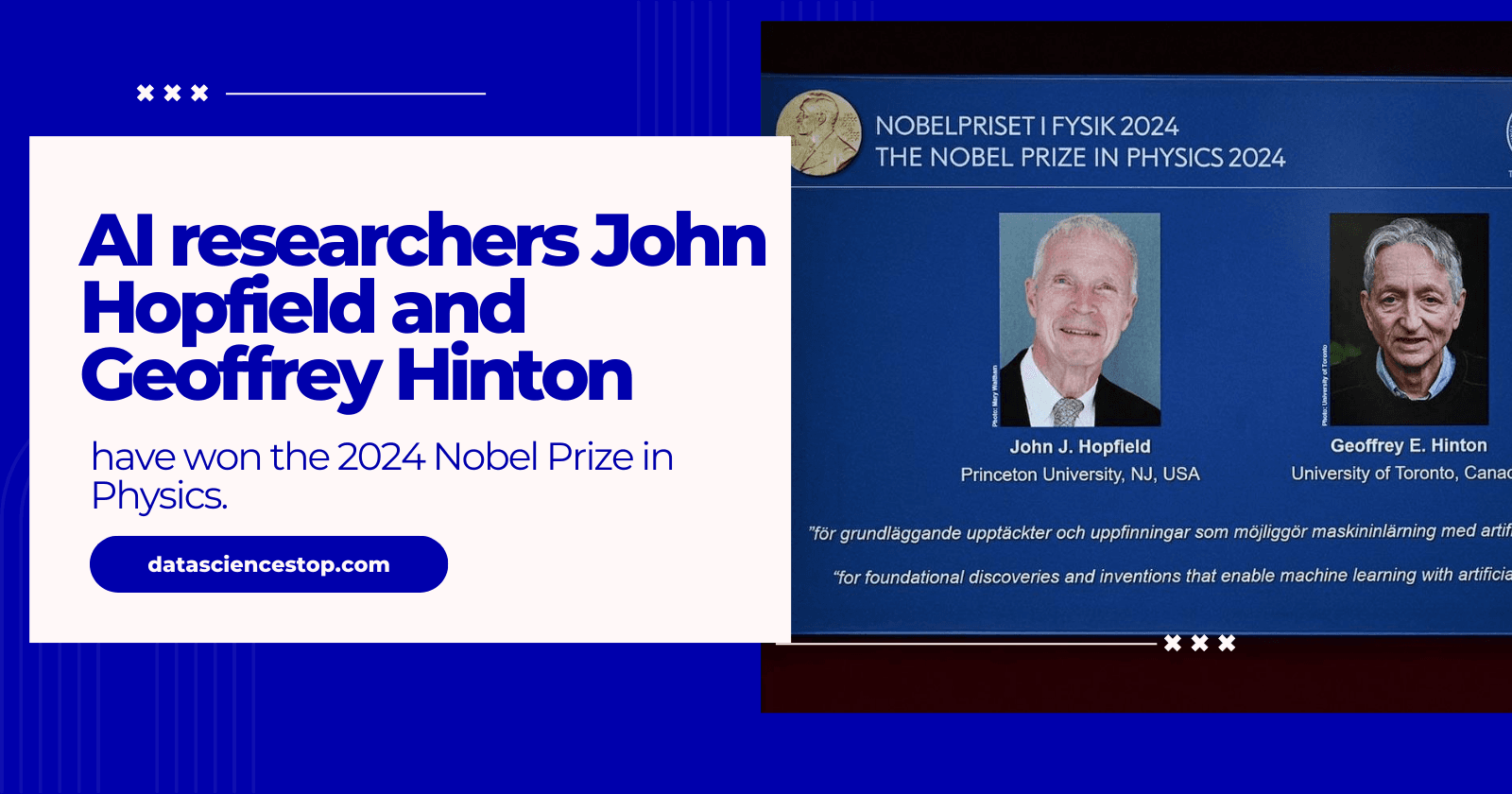
AI researchers John Hopfield and Geoffrey Hinton have won the 2024 Nobel Prize in Physics.
Search for a command to run...
No comments yet. Be the first to comment.
ChatGPT's innovative new shopping tools are revolutionizing internet shopping through bespoke recommendations, streamlined searching, and future-proof

Alibaba's cutting-edge Qwen 3 AI raises the bar in China's competitive tech scene with hybrid reasoning, multi-language capabilities
our comprehensive guide to HiggsFieldAI, StanfordAI, GenSpark, Veo2, Hunyuan3D, Adaptive AI, and Seedream 3.0. Discover their unique purposes, features, and potential. The AI landscape is ever-changing, with new platforms and tools developing at bre...
Discover features, advantages & disadvantages, and tips to select the perfect tool for your creative purposes—no design expertise needed!
Perplexity AI's latest iOS Voice Assistant transforms on-device AI activities—book a reservation, send an email, play media & more with voice commands. A Siri alternative with real-time web search and multi-app integration Perplexity's voice assista...
AI researchers John Hopfield and Geoffrey Hinton have won the 2024 Nobel Prize in Physics.
Image source :Forbes India
Nobel Prize 2024 in Physics Awarded to Two Pioneering AI Scientists: John Hopfield and Geoffrey Hinton Rewarding pioneering work in machine learning and neuroscience, this historic recognition upon two trailblazing scientists in AI focuses on the impacts of AI on understanding complex physical systems. Given the integral role that has had to be played in the development of AI, there is an imperative that, as the field continues to evolve, foundational work executed alongside these current improvements be appreciated.
John Hopfield is most renowned for introducing the concept of Hopfield Networks back in the 1980's. The work opened our understanding of how biological systems might be understood with computational frameworks in associative memory.
1.Biological Inspiration
The Hopfield Networks mirror the brain in fetching its memory, and are therefore influential in solving optimization problems.
In that they are able to represent as binary what the neurons can store and recollect patterns of binary data successfully.
2. Physics Applications
They have been assimilated in Hopfield's concepts to solve complex problems, such as statistical mechanics and quantum computing.
They permit physicists to restorative the phase transitions in addition to collective behaviour of particles in a way that reconstructs dynamics close to reality.
Hopfield's work goes beyond jusConclusiont computational intelligence; it connects physics and biology, resulting in algorithms that can handle large datasets effectively, like those used in physics experiments.
Geoffrey Hinton Known to some as the "godfather of deep learning," He greatly impacts the AI front through his research work on neural nets. His discovery of backpropagation algorithms associated with deep networks popularized data processing in ways that have changed the way things operate.
1. Basic Theory
His work in the deep belief network predates modern applications of AI in the computing field that generated results in computer vision and natural language processing.
His work anchors on multi-layered architecture, augmenting model capacity to learn as well as generalize from complex data.
2. Interdisciplinary Applications
Hinton's new models are applied to a crosscutting of applications: image recognition, where they outperform old algorithms and in physics
They help to scan high-dimensional data from particle collisions and cosmic simulation.
The influence of Hinton to the field of AI is not only elevating the field but also collaborating to bridge AI with scientific research. His continued work is striving to make networks more efficient and capable of learning from fewer examples, which would play a central role in areas where real-world constraints come into play.
Revolutionizing How Scientists Approach Complex Problems and Their Interpretations.The development of Hopfield and Hinton marks a constantly growing intersection of AI and physics. This is fundamentally changing how scientists engage with complex problems, and crucially, how they interpret their results.
1. Data-Driven Discovery
Predict novel hypotheses by leveraging the power of machine-learning models within giant data sets pertinent to experimental physics.
The simulation and visualization possibilities which AI offers let one simulate phenomena unattainable at an earlier time, such as simulating quantum states or even astrophysical events.
2. Reinforced Predictive Models
With the principle of pattern recognition and predictability, AI allows physicists and their collaborators to correct the theoretical models towards reconciliation with empirical evidence
A change in structure of theory building and testing in science.
The decision to give the 2024 Nobel Prize in Physics to John Hopfield and Geoffrey Hinton marks a significant point in the histories of both artificial intelligence and physical sciences. Their work has greatly changed how we tackle difficult problems, enabling new methods that connect different fields of study. As AI technology keeps improving, their foundational research will be a key guide for new scientists and inventors. In the end, their accomplishments show us that the quest for knowledge has no limits, and combining different scientific areas will lead to future advancements.
References
2.The Nobel PrizeAnnouncements7–14 October 2024
3.John Hopfield and Geoffrey Hinton awarded Nobel Prize in physics
More Recent News


