

When AI changes the way we do science, will we understand the results?
Search for a command to run...
No comments yet. Be the first to comment.
ChatGPT's innovative new shopping tools are revolutionizing internet shopping through bespoke recommendations, streamlined searching, and future-proof

Alibaba's cutting-edge Qwen 3 AI raises the bar in China's competitive tech scene with hybrid reasoning, multi-language capabilities

our comprehensive guide to HiggsFieldAI, StanfordAI, GenSpark, Veo2, Hunyuan3D, Adaptive AI, and Seedream 3.0. Discover their unique purposes, features, and potential. The AI landscape is ever-changing, with new platforms and tools developing at bre...
Discover features, advantages & disadvantages, and tips to select the perfect tool for your creative purposes—no design expertise needed!
Perplexity AI's latest iOS Voice Assistant transforms on-device AI activities—book a reservation, send an email, play media & more with voice commands. A Siri alternative with real-time web search and multi-app integration Perplexity's voice assista...
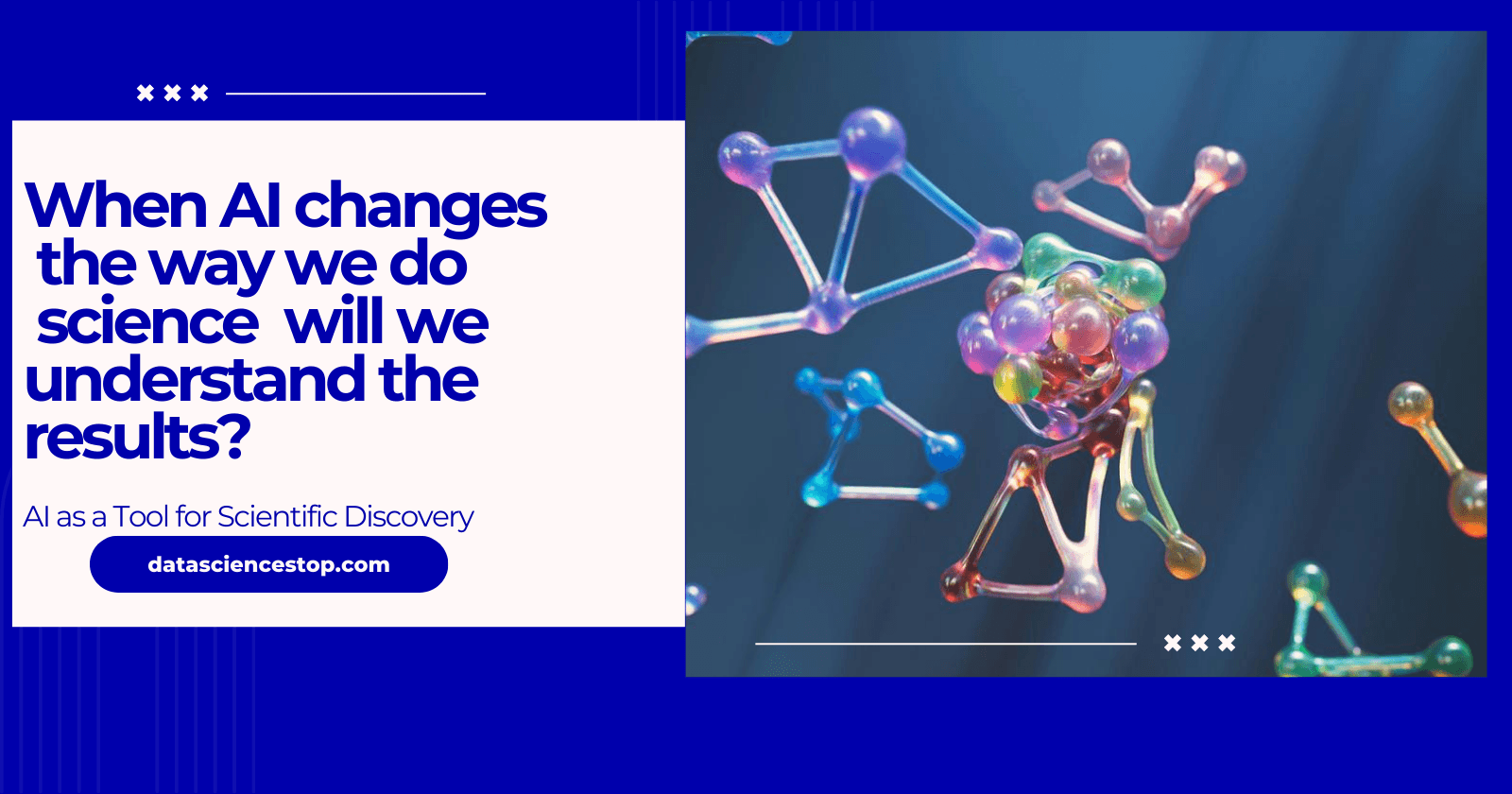
When AI changes the way we do science, will we understand the results?
The integration of artificial intelligence (AI) in scientific research is changing how experiments are conducted, how data is analyzed, and what the results mean. Advances in AI technologies promise capabilities that could revolutionize the scientific process. At the same time, important questions arise about our comprehension of the findings generated by AI systems.
AI can take on so many different roles in scientific discovery.
Data Analysis algorithms AI can analyze great quantities of data much, much greater than that even a human can notice anything unusual that might be embedded in such data. Astronomical data may therefore be analyzed by an AI system to detect supernovae or probe the evolutionary history of galaxies, leading thereby to an enhanced understanding of the universe.
Hypothesis Generation: The use of machine learning models enables scientists to generate new hypotheses with the help of available data. These models predict outcomes and propose experiments that human researchers may not have tried before.
Automation of Experiments: AI can automate the experimentation process, carrying out a number of tests that even human researchers cannot achieve or do at such speed. This enables the testing of hypotheses on a larger scale with faster validation of results .
Despite these strides, an important challenge, which must be addressed to make use of AI truly beneficial, is the understanding that underlines the reasoning and conclusions derived from AI's outputs. Most AI systems are opaque, that is even though the system is able to give you some predictions or insights, outputs of the system are really opaque.
The following presents some key issues:
Interpretability: AI results will be intractable in case ambiguous knowledge of the algorithms involved or methods of processing of data. This, yet again, limits trust.
Scientific Understanding: According to Nature, the study shows proper scientific understanding not only to give the result but how such a result was arrived at. Three ways that AI may be able to provide for scientific understanding it will be a kind of computational microscope that can enable one to see the new features of the world, become a source of inspiration in terms of new ideas that come, and it is possible to act as an agent capable of autonomously generating understanding.
There is a need to collaborate in terms of how humans would like the output and what should be the kind of result produced by the AI since that's really where understanding lies, filling the gaps of the actual comprehension through human understanding with AI support.
Challenges go further into connecting knowledge with the difficulties of translating AI results. While it holds the promise of empowering us in doing research and discovering more, it would be a huge challenge enabling the scientists to interpret the output as trustable input so that the outcome of these investigations could help in carrying out good science in the future. Bringing power together in the machine and way opening to human insight can very significantly unlock the best way to tap into progressing scientific knowledge.
On Scientific Understanding with Artificial Intelligence - Nature
Eric Schmidt: This is how AI will transform the way science gets done
How Artificial Intelligence Is Changing Science | Quanta Magazine

